
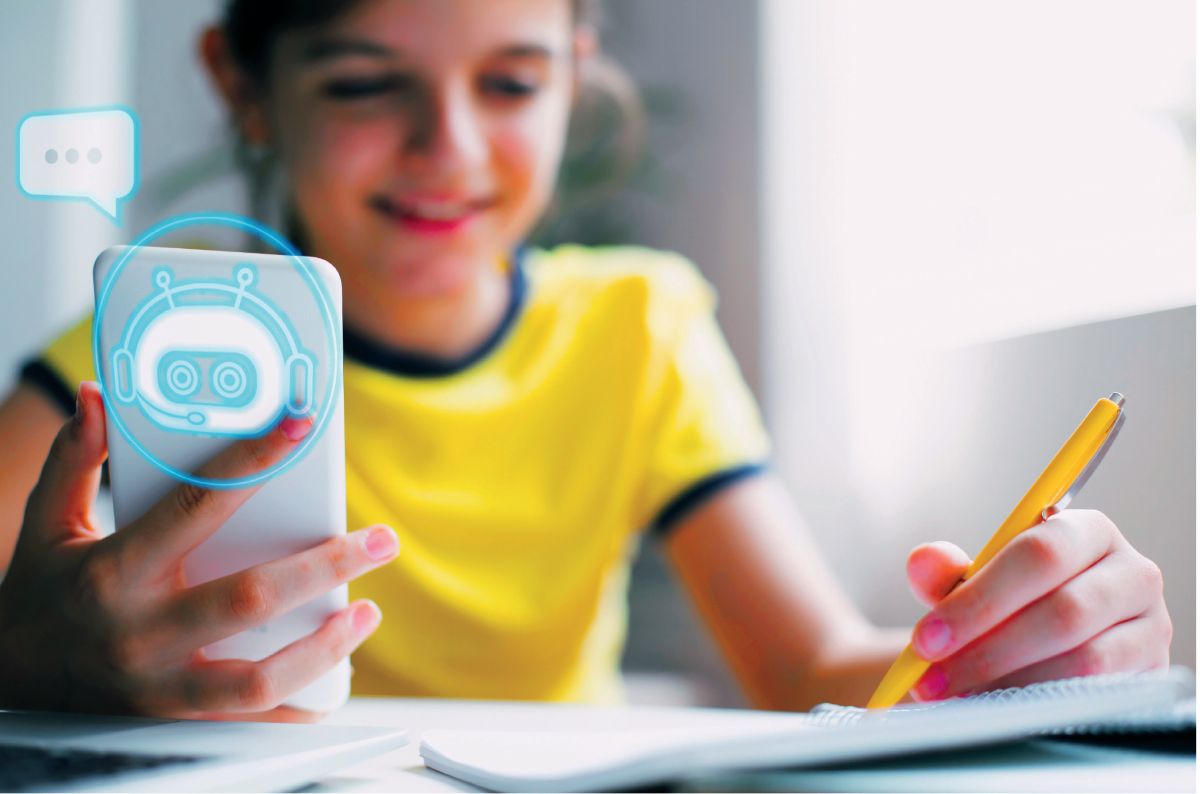
Artificial intelligence (AI) has drastically changed today’s technological landscape. Often running behind the scenes, AI impacts the consumer experience across many industries. As AI continues to progress in its sophistication, application and accessibility, families are navigating yet another new frontier that carries both risks and rewards for today’s youth.
Teaching your kids about AI
“Artificial intelligence has been around for a long time but has reached a tipping point where it has moved from the background to the forefront of day-to-day life,” says Jeremy Waller, a father of four and director of consulting services and AI with Oklahoma City’s Phase 2, a custom software development company. “My kids won’t remember a world that didn’t have computers you could talk to. As parents, we have to think about how we can equip our kids to use these tools safely and effectively.”
A chatbot, as defined by IBM, is a computer program that simulates human conversation with an end user, using large language models (LLM) to generate responses. Understanding how these tools function is the first step in helping families recognize the dangers of AI.
“It feels like you’re talking to a person, but it’s a computer,” says Waller. “It’s important for kids to understand that even though the responses sound friendly, it’s not a real person or friend. As adults, we can struggle with recognizing when something is AI-generated, so it’s even more difficult for kids with less experience to distinguish between what’s real and what’s not.
“These models are designed to be agreeable and helpful to a fault. Because of this, the models can provide false information and encourage kids to do something wrong. The safeguards in place aren’t 100% successful, and sadly there have been stories of kids who have hurt themselves or others because of interactions with this technology.”
Building digital literacy and critical thinking skills
When AI generates a response or output that is inaccurate, misleading or illogical, it’s called a hallucination. And for end users, a.k.a. humans, it’s our job to recognize these hallucinations as false information.
“We can’t blindly trust the technology,” says Waller. “We have to teach ourselves and our kids to ask questions. There’s no expectation for parents to be AI experts, but instead try to be engaged partners in their child’s digital education. This was true when we were learning how to use computers, the internet and smartphones. We shouldn’t be afraid of technology but rather cautious and willing to learn alongside our kids.”
With more accessible AI, Waller believes it can be a positive accelerator in many areas, supporting greater learning opportunities and fostering more creativity.
“Not only does AI offer access to a world of information, it allows it to be presented in a way that can be consumed easily, allowing for language differences, different learning styles and could impact literacy gaps,” says Waller. “With these technologies, there is a much more direct line between our imagination and the end result. If we can imagine it, we can use these technologies to create really fantastic things.”
Teaching kids about AI early, he says, helps them become responsible digital citizens who can spot risks and maximize creative potential.
AI’s impact on education
With the rise of AI, there has been debate around its use in education. Benefits include more personalized and adaptive learning experiences, improved accessibility and greater administrative efficiency. Potential risks range from data privacy concerns to an over-reliance that may hinder critical thinking skills.
Eric Hileman, executive director of Information Technology Services (ITS) for Oklahoma City Public Schools (OKCPS), says facilitating the use of AI in education encompasses multiple areas, including curriculum, legal, educational technology and more.
“At OKCPS, we’ve created an advisory panel and adopted strategies that allow the use of AI in an ethical, safe and productive manner built around teaching students how to use these technologies responsibly,” says Hileman.
He says excitement around AI in education stems from its possibilities to enhance learning opportunities, from helping solve problems, improving writing skills and serving as a personal tutor for differentiated instruction on a broad scale. However, he emphasizes that digital literacy skills are essential to safely and effectively using AI.
“If you’re outsourcing your cognitive load and don’t critically think about the content it’s producing, then you’re not developing those skills,” says Hileman. “The four Cs of 21st-century skills — collaboration, communication, critical thinking and creativity — still apply. Students may use AI as a brainstorming tool, but they still need to follow up with their own reflection and verify the accuracy of the information they’ve been given.”
Hileman encourages parents to try these
AI models and discuss their findings with their kids.
“Look at it from a kid’s lens and think about what they might look up or be interested in,” says Hileman. “Teaching our kids how to safely use AI and engaging in conversations around this technology is one of the most important things we can do.”
AI as a tool for creativity and inclusion
Dr. Laura Dumin, an English professor, director of the Technical Writing B.A. program and AI campus coordinator at the University of Central Oklahoma in Edmond, shares the concern that students should use AI to support learning experiences, not replace them.
“Students need to consider what they’re gaining and what they’re losing by using AI,” says Dumin. “Are they using it to get better at something or as a crutch or way to avoid doing something? If a student is using AI to help provide an outline or structure for a report, then it’s helping them complete a task.
“However, if they’re needing to write a history paper and don’t want to read about it, then they’re missing that learning opportunity. I think there’s a risk of students not realizing what they’re losing by not using their own creativity to build something.”
Dumin, who studies and speaks on how generative AI is impacting education, encourages her students to use AI as a collaborative tool.
“I’ve found that students who struggle with anxiety when starting a project can sit down within one of these large language models and successfully brainstorm on a topic to get started,” says Dumin. “As someone who identifies as neurodiverse, I use Claude AI to assist in creating topic outlines that help me better understand societal and audience expectations, while also identifying discussion areas I need to strengthen or include.”
Even as AI technologies continue advancing, Dumin believes that critical thinking, verified research and independent creativity will remain essential skills.
“Despite AI’s capabilities, we have to keep our brains on and stay actively engaged to question and analyze AI’s output, not accept it at face value,” says Dumin.
Exploring these tools together not only builds digital literacy but also creates opportunities to talk openly about the dangers of AI, including misinformation, overreliance and privacy risks. These shared experiences empower kids to safely navigate technology with greater awareness and confidence.
Toys & tools to help kids understand AI
• Talk about AI with your kids. Offer age-appropriate examples such as AI-powered toys, games and assistants such as Alexa or Siri.
• Encourage kids to consider the pros and cons of AI and how it can affect the way they learn.
• Explore AI chatbots together. Discuss responses to help kids use AI as a safe and responsible tool.
Editor’s note – Want to learn more about hidden dangers of AI for kids and how parents can respond? Ashley Coffey, principal consultant at Coffey & Consult, LLC and a technology educator and digital literacy advocate, shares her insights on how to recognize what’s real, what isn’t and what has harmful real-life consequences.